Candlestick Toolkit: Checklists for Better Trade Plans
Why a Candlestick “Toolkit” Beats Memorizing Patterns
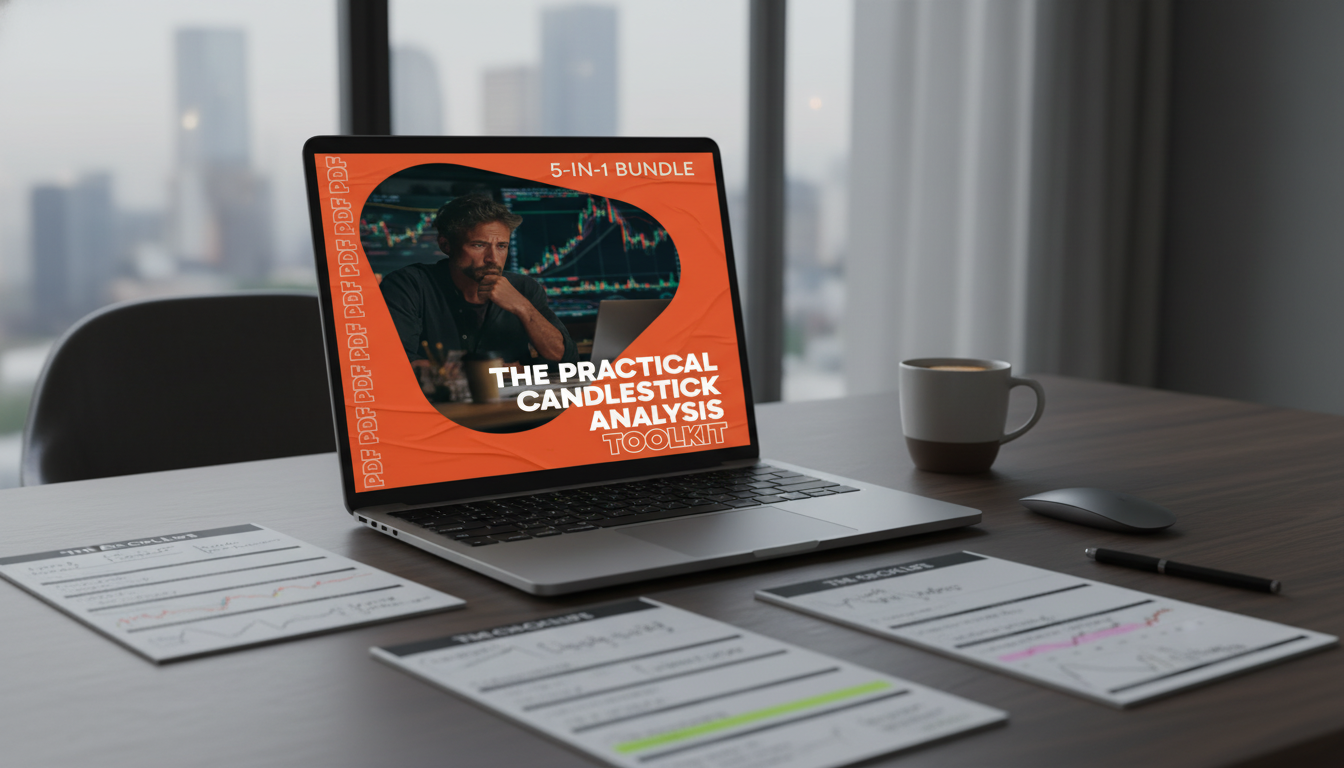
Candlestick charts can look deceptively simple: a few rectangles and wicks that seem to “tell a story.” In real trading, consistency comes less from spotting a single candle and more from following repeatable rules—context first, then confirmation, then a plan with defined risk. That’s the gap The Practical Candlestick Analysis Toolkit: 5-in-1 Bundle of Guides, eBooks & Checklists is designed to fill: turning pattern recognition into a practical workflow you can run across markets and timeframes.
Instead of treating candlesticks like magic signals, this bundle aims to build a steady routine: scan, confirm, plan, manage risk, and review. If you already know basic charting but want a more structured way to make decisions under pressure, a checklist-driven approach can help reduce impulsive entries and “pattern chasing.”
What the Toolkit Is Designed to Do
- Organize candlestick study into a step-by-step routine rather than isolated pattern memorization.
- Provide quick-reference guides for fast chart reviews when time is limited.
- Use checklists to reduce impulsive entries and pattern-chasing behavior.
- Encourage confirmation and context: trend, key levels, volatility, and risk parameters.
- Support post-trade review habits to improve decision quality over time.
This emphasis on “process over prediction” aligns with how reputable education sources frame candlesticks—as definitions and examples that require context to be useful. For a foundational overview of what common candlestick patterns represent, see Investopedia’s candlestick charting guide.
Who It Fits Best
- Beginner-to-intermediate traders who understand basic charting and want more structure.
- Swing traders and day traders who need a consistent pre-trade checklist.
- Traders rotating between markets (stocks, forex, crypto, indices) who want a universal visual framework.
- Self-directed learners who prefer guided reading plus actionable templates.
- Anyone seeking a compact reference system to keep beside a trading platform.
What’s Inside the 5-in-1 Bundle
- Guides and eBooks that break down candlestick behavior and common setups in plain language.
- Pattern and setup checklists meant to be used before placing an order.
- A process-driven approach that emphasizes context: location on the chart matters more than the candle alone.
- Practical frameworks for planning entries, invalidation points, and risk sizing.
- Templates intended to support consistent review and skill-building.
Because the materials are digital, they’re built for quick lookups during chart time and for structured practice sessions. The goal is to make the “right next step” easy to identify—especially when the market is moving fast.
A Practical Workflow for Using the Guides and Checklists
One of the most useful ways to use a candlestick toolkit is as a repeatable routine. The exact indicators or markets can vary; the sequence stays stable.
- Start with market context: Identify trend direction and recent structure (higher highs/lows, ranges, breakouts).
- Mark key levels: Prior highs/lows, visible support/resistance, gaps, and round numbers where relevant.
- Scan for a candlestick clue at a meaningful location: Rejection, indecision, or momentum near a level.
- Confirm with one additional factor: Volume behavior, volatility regime, or a simple indicator used consistently.
- Define the trade plan: Entry trigger, stop placement based on invalidation (not comfort), and a target concept.
- Use a checklist to catch contradictions: For example, a reversal candle against a strong trend without evidence of exhaustion.
- After the trade, record and review: Screenshot, notes, what was seen, what was missed, and whether rules were followed.
Common Candlestick Signals and What to Check Before Acting
| Candle clue | Best used when | Confirmation to look for | Common mistake |
|---|---|---|---|
| Rejection wick / pin-type candle | At a well-defined support/resistance or swing level | Next candle follow-through or break of micro-structure | Taking it mid-range with no level |
| Engulfing candle | After a clear push into a level or after a failed breakout | Close relative to range + context (trend/range) | Ignoring volatility and stop distance |
| Doji / indecision | When price is compressing near a decision point | Directional break and close beyond nearby pivot | Treating indecision as an immediate reversal |
| Strong momentum candle | Trend continuation after consolidation | Retest behavior or sustained closes above/below level | Chasing after an overextended move |
Risk Control and Trade Planning Essentials
Market risk is real and can change quickly. For plain-language reminders on volatility and trading risk, review the CFTC’s advisories and the SEC’s overview of risk and return.
How to Study Faster Without Missing Nuance
Getting the Bundle (and a Helpful Add-On for Mindset)
If you want structured candlestick materials you can reference while trading, The Practical Candlestick Analysis Toolkit: 5-in-1 Bundle of Guides, eBooks & Checklists is built as a compact digital system: guides for learning, checklists for pre-trade discipline, and templates for review.
For traders who also want support around consistency and mental habits, pair it with Benefits of Positivity Bundle: Fuel Your Mind, Build a Positive Mindset & More to reinforce the routine side of execution—showing up, following rules, and reviewing results without spiraling after a win or loss.
FAQ
Is candlestick analysis enough to trade profitably on its own?
Candlesticks are best used as a decision aid, not a complete trading system. Profitability typically depends on combining candles with context (trend and key levels), a defined trade plan, and consistent risk management.
How long does it take to get comfortable reading candlesticks?
Many traders start feeling more fluent after a few weeks of focused practice, but real confidence often takes a few months of consistent journaling and review. Limiting your focus to a small set of setups and using checklists can speed up pattern recognition.
Can the same candlestick patterns be used for stocks, forex, and crypto?
Yes—candlestick behavior is broadly applicable across markets, but volatility, liquidity, and session structure can change how signals play out. Adapting confirmation rules and position sizing to the market’s conditions is often more important than the pattern name.












Leave a comment