AI Audience Research Toolkit: 60-Minute Insight Sprint
AI Audience Research Without the Sprawl
Audience research often ends up fragmented: a few customer quotes in one doc, competitor notes in another, and “best guesses” scattered across ad accounts and analytics. When inputs aren’t organized the same way every time, it’s easy to miss patterns—especially the ones that explain why certain people browse, while a smaller subset actually buys. For more guidance, see Beyond the Hype: ‘Springing’ Insights Ahead with Actionable AI ….
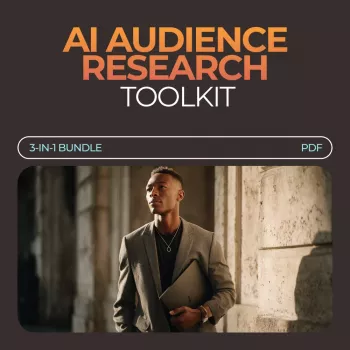
The AI Audience Research Toolkit – 3-in-1 Digital Bundle for Targeted Market Insights is built to pull those scattered signals into a repeatable workflow. Instead of starting from scratch for every campaign or product launch, you can define segments with consistent criteria, capture “voice of customer” evidence, and translate findings into messaging that’s ready for ads, landing pages, emails, and product pages. For further reading, see Marketing research on Mobile apps: past, present and future – PMC.
What This 3-in-1 Bundle Helps You Do
- Identify high-value audience segments using consistent criteria (needs, motivations, objections, context of use).
- Turn messy inputs (reviews, forums, competitor pages, analytics notes) into structured insight categories.
- Build repeatable workflows that reduce time spent on manual research and rework.
- Create clearer positioning inputs for ads, landing pages, email sequences, and product pages.
Rather than treating audience research as a one-time “persona project,” this approach supports ongoing updates—so your messaging keeps pace with shifts in demand, seasonality, and new competitors. For additional background on persona-based research and how it supports real design and content decisions, Nielsen Norman Group’s guidance is a solid reference: https://www.nngroup.com/topic/personas/.
Who It’s For
- Ecommerce brands refining product messaging and bundles based on customer language.
- Creators and course sellers validating niche angles and objections before building a new offer.
- Marketing teams needing faster persona updates for campaigns and seasonal launches.
- Agencies that want a standardized way to deliver audience insights to clients.
If you’re already collecting feedback (reviews, returns reasons, customer support tickets) but not consistently translating it into angles and objections you can deploy, this toolkit fits neatly into that gap.
Core Outcomes to Expect
- Sharper segmentation: clearer differences between “who buys” and “who actually converts.”
- Better message-market fit: benefits mapped to real motivations and friction points.
- More targeted content planning: topics prioritized by intent and stage of awareness.
- Reduced wasted spend: improved ad angles and landing page clarity from the start.
Many teams already have “audience” data inside analytics, but the missing step is turning it into usable decisions—what to say, what to prove, and what to prioritize. If you want to align what you see in performance data with a clearer audience structure, Google’s overview of audiences in Analytics is helpful context: https://support.google.com/analytics/topic/10096889.
How to Use the Toolkit in a 60–90 Minute Research Sprint
Instead of waiting for a “perfect” dataset, run a fast, disciplined sprint that produces draftable messaging. The goal is momentum: a first version of segments and angles you can validate quickly.
- Collect inputs: pull customer reviews, support tickets, Q&A threads, competitor reviews, and on-site search terms.
- Tag and cluster: group phrases by job-to-be-done, desired outcomes, objections, and decision triggers.
- Define segments: create 3–5 primary segments with distinct goals and purchase barriers.
- Translate into assets: draft a messaging matrix (headline, promise, proof, CTA) per segment.
- Validate quickly: sanity-check with small tests (ad variations, email subject lines, landing page hero copy).
Sprint checklist: inputs → insights → outputs
| Step | What to gather or produce | Practical output |
|---|---|---|
| 1. Inputs | Reviews, forum threads, competitor positioning, FAQs | A single research dump document |
| 2. Clustering | Themes: motivations, objections, desired results | 5–10 insight clusters |
| 3. Segmentation | Distinct needs and contexts of use | 3–5 audience segments |
| 4. Messaging | Benefits + proof + angle per segment | A messaging matrix |
| 5. Quick tests | Small experiments across channels | Early winners for scaling |
What to Look For When Comparing Audience Research Bundles
It’s also worth checking whether the workflow helps you preserve evidence. When a segment definition is backed by real quotes, patterns, and examples, it’s far easier to get alignment across teams—and to write copy that sounds like customers rather than “marketing.” HubSpot’s market research overview is a good primer on methods and sources you can pull into the same workflow: https://blog.hubspot.com/marketing/market-research-buyers-journey-guide.
Common Mistakes That Reduce Insight Quality
Bundle Details and Access
Product snapshot
| Item | Details |
|---|---|
| Name | AI Audience Research Toolkit – 3-in-1 Digital Bundle for Targeted Market Insights |
| Price | 292.99 USD |
| Availability | In stock |
| Product page | View product |
Related In-Stock Digital Bundles
- AI Audience Research Toolkit – 3-in-1 Digital Bundle for Targeted Market Insights
- Benefits of Positivity Bundle: Fuel Your Mind, Build a Positive Mindset & More
- The Ultimate Potato Pack for Cozy Dinners – 10-in-1 Digital Recipe Bundle with Different Potato Recipes, Comfort Food Guides & Cheesy Classics
FAQ
Is this bundle useful without running surveys or interviews?
Yes. It’s designed to work with existing sources like reviews, support logs, community posts, on-site search terms, and competitor feedback. Surveys and interviews can deepen your insights, but they aren’t required to produce usable segments and messaging angles.
How quickly can audience insights be turned into campaign messaging?
You can generate initial angles in a same-day 60–90 minute sprint by clustering inputs and building a simple messaging matrix. Allow a few additional days to validate and refine winners through small tests like ad variations, email subject lines, or landing page hero copy.
What kinds of businesses benefit most from targeted market insights?
Ecommerce brands, digital product sellers, agencies, SaaS teams, and even local services benefit when they serve multiple customer types or face competing positioning angles. Any business that needs clearer segments, sharper objections, and stronger proof can use targeted insights to improve clarity and conversion.











Leave a comment