Stock Market Toolkit: 10 Checklists for Better Trades

Practical Toolkit for Navigating the Stock Market: 10 Guides, Checklists, and eBooks for Confident Decisions
Stock market learning often breaks down at the exact moment action is required—placing a trade, interpreting news, sizing a position, or reviewing results. A practical toolkit helps convert concepts into repeatable steps with checklists, templates, and quick-reference guides that support consistent decision-making from planning through post-trade review.
What a “practical toolkit” changes compared with generic investing advice
- It turns broad ideas (risk, diversification, valuation, timing) into step-by-step workflows you can reuse instead of relying on memory in the moment.
- It reduces missed steps with pre-trade and post-trade checklists—especially when volatility makes it tempting to rush.
- It creates a written decision trail, which makes patterns easier to spot (overconfidence, late entries, weak exits) and easier to fix.
- It supports a process-first approach: define criteria, execute consistently, then evaluate outcomes—without rewriting rules after every win or loss.
Inside the 10-in-1 bundle: how each resource fits into a full investing routine
A well-designed bundle works like a loop: learn the mechanics, research with structure, manage risk before entry, execute with intention, then review results. The pieces below are meant to be used together, not as random downloads.
- Getting started guide: Clarifies account types, basic order types, and market mechanics so early trades aren’t derailed by avoidable execution mistakes.
- Research checklist: Structures due diligence—business model, financials, catalysts, and risks—so decisions aren’t driven by a single headline or a “hot tip.”
- Risk management checklist: Keeps the focus on position sizing, stop/exit planning, and portfolio exposure limits before a trade is placed.
- Trade execution guide: Walks through common order types and how to think about liquidity, spreads, and timing when entering or exiting.
- Portfolio review template: Sets a cadence for reviewing allocation, concentration, and performance versus goals so drift doesn’t quietly grow.
- Behavior and discipline prompts: Encourages pre-commitment rules that reduce impulse trades, overtrading, and “revenge trading” after a loss.
For foundational investor education beyond any single toolkit, it helps to periodically cross-check your understanding with resources like Investor.gov (SEC Investor Education) and FINRA’s Investing Basics.
How to use the toolkit: a simple weekly workflow
Consistency matters more than intensity. A light, repeatable schedule can outperform sporadic deep dives followed by rushed decisions.
- Day 1 (Plan): Set objectives for the week, define watchlist criteria, and confirm risk limits before scanning opportunities.
- Day 2 (Research): Use the checklist to evaluate candidates; write down the entry thesis and the specific data points that would invalidate it.
- Day 3 (Execute): Choose an order type that matches the plan (market vs. limit), confirm size, and document the rationale in a sentence or two.
- Day 4 (Monitor): Track only the metrics that matter to the thesis; avoid constant price-checking unless a decision trigger is hit.
- Day 5 (Review): Complete a short post-trade and portfolio review—what worked, what didn’t, and what to adjust next week.
Common mistakes the checklists help prevent
- Buying without a defined exit plan: Profit-taking and loss-limiting rules decided after emotions rise tend to be late and inconsistent.
- Over-sizing a position: Confidence after recent wins can inflate position size and create outsized portfolio swings from a single name.
- Confusing a good company with a good price: Skipping valuation or ignoring changing conditions can turn a solid business into a poor entry.
- Chasing headlines: Fast news can feel actionable, but a checklist forces a pause to confirm the impact on fundamentals and the original thesis.
- Neglecting costs and frictions: Spreads, fees, taxes, and slippage can quietly erode returns—especially with frequent trading.
Quick reference: toolkit components and when to use them
To keep things simple, think in three timeframes: before a trade (decision quality), after a trade (learning), and at the portfolio level (alignment with goals).
Toolkit map: component → purpose → best moment to use
| Component | Purpose | Best time to use | Output to save |
|---|---|---|---|
| Market basics guide | Build foundational understanding of orders, exchanges, and terminology | Before first trades and when learning a new order type | Glossary notes + order-type decision rules |
| Research checklist | Standardize evaluation of a stock and reduce skipped steps | Before entering or adding to a position | Written thesis + key risks + invalidation triggers |
| Risk management checklist | Control downside and exposure at the position and portfolio level | Immediately before placing an order | Position size + exit plan + max loss estimate |
| Execution guide | Improve order placement and reduce avoidable slippage | At trade entry and exit | Order details + rationale for market/limit choice |
| Review templates | Learn from results and refine rules over time | Weekly for trades; monthly/quarterly for portfolio | Performance notes + rule adjustments |
Who benefits most from a stock market toolkit
What to look for before buying a digital investing bundle
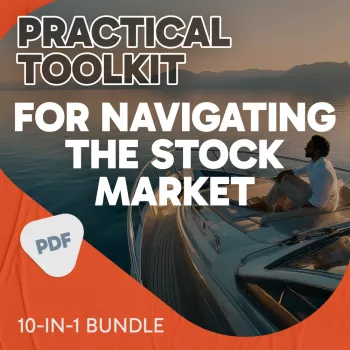
Product snapshot: Practical Toolkit for Navigating the Stock Market (10-in-1)
Shop the bundle here:
Practical Toolkit for Navigating the Stock Market (10-in-1 Guides, Checklists & eBooks)
For traders who want extra support on the mindset side—especially for sticking with rules during drawdowns—pairing a process toolkit with a mental habits resource can be helpful:
Benefits of Positivity Bundle: Fuel Your Mind, Build a Positive Mindset & More
FAQ
Is a checklist-based toolkit useful if investing is long-term?
Yes—use checklists for entries, risk limits, and periodic portfolio reviews. Long-term horizons still benefit from consistent criteria and documented decisions, especially when markets get noisy.
Does a stock market toolkit replace financial advice?
No—think of it as an educational process tool for organizing decisions and risk controls. For personalized recommendations based on your full financial picture, consider a licensed professional.
How quickly can a beginner start using the templates?
Start with the basics guide and one pre-trade checklist, and apply it to a watchlist first. Then use it for small, controlled trades while building a weekly review habit.










Leave a comment